Project Approved: Building the Foundation
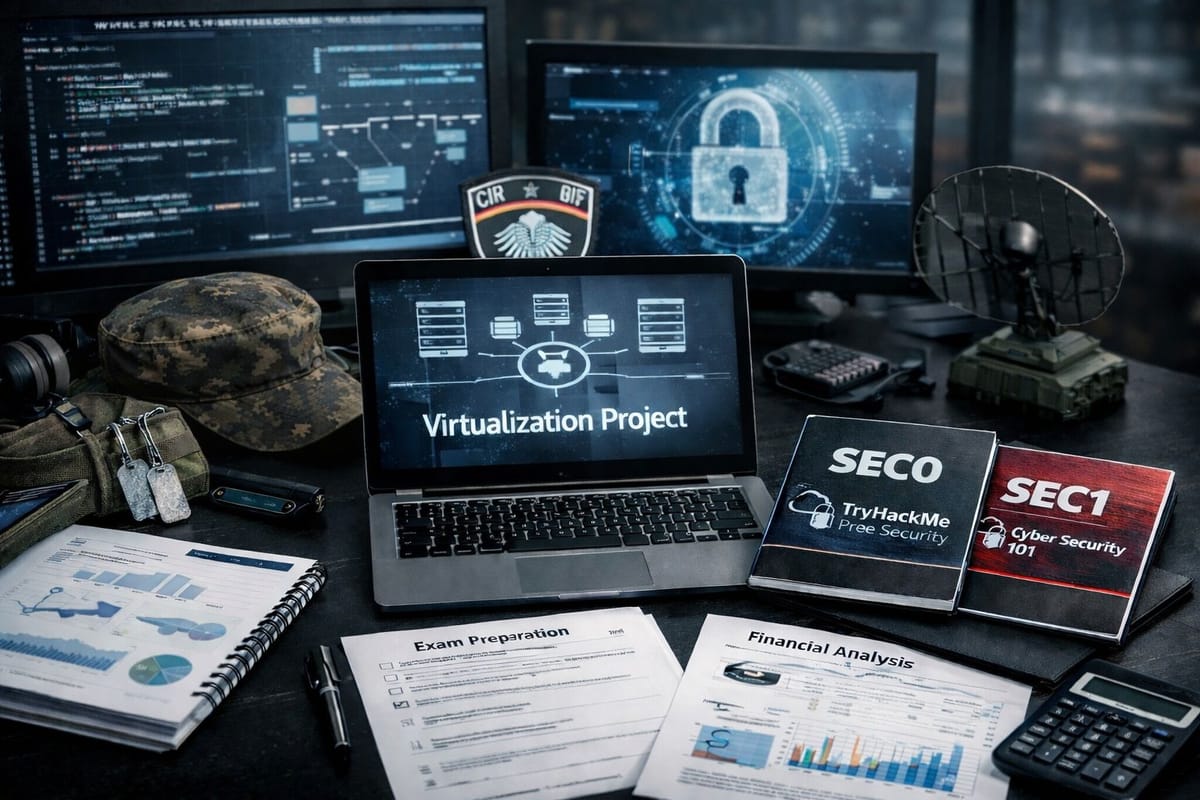
My final project topic has officially been approved by the Chamber of Commerce and Industry. The project, titled “Introduction of a Centralized Virtualization Environment to Replace Outdated Workstation Systems,” marks the most important milestone of my training so far. Over the next three weeks, my full attention will be dedicated to planning, implementing, and documenting this initiative.
The core objective is the transition from decentralized, aging workstation systems to a centralized on premises virtualization environment. The company already operates its own server infrastructure, which creates a solid foundation for this shift. Instead of investing in a completely new platform, the existing hardware will be upgraded with additional RAM and storage capacity. The challenge lies in dimensioning the resources correctly so that the environment can reliably handle the projected number of concurrent users without performance degradation.
The initial phase will focus on designing and deploying a pilot environment. This pilot is not merely a test setup but a strategic blueprint for the future company wide rollout. Every configuration decision, performance benchmark, and architectural choice must be carefully documented, as it will later serve as the reference for scaling the solution across the organization. Stability, scalability, and maintainability are central design principles throughout this process.
From a technical perspective, this project requires careful planning of virtualization hosts, storage allocation, network segmentation, backup strategies, and user profile management. Resource pooling, centralized administration, and simplified patch management are among the operational advantages expected from the new architecture. At the same time, potential bottlenecks must be identified early, especially with regard to storage throughput and memory allocation under peak load conditions.
Financial Evaluation and Strategic Justification
Beyond implementation, the project includes a detailed economic analysis. The decision to consolidate workstation systems into a centralized infrastructure must be justified not only technically but financially. This involves calculating acquisition costs for hardware upgrades, estimating operational savings, and determining amortization periods.
Centralized virtualization reduces long term hardware replacement cycles on client devices, simplifies support processes, and minimizes downtime. These factors translate into measurable cost savings. By comparing current expenditure on distributed workstation maintenance with the projected operational model, the return on investment can be clearly demonstrated. The pilot environment will provide the data necessary to support these calculations with realistic metrics rather than theoretical assumptions.
Time management plays a crucial role. After these three intensive weeks, my preparation phase for the final written exams begins immediately. The written examinations take place on April 29, followed by the project submission deadline on May 6. Completing the implementation and documentation efficiently is essential so that I can shift my focus entirely to exam preparation without unresolved technical tasks in the background.
Structured Skill Development Through Certification
Once both the project and exams are completed, I will redirect my focus toward certifications to strengthen and formalize my cyber security knowledge. During a recent promotion, I purchased two certifications from TryHackMe, each valid for one year: SEC0 and SEC1.
The SEC0 certification, officially known as the TryHackMe Certified Pre Security exam, is designed as a practical, foundational assessment. It validates understanding of how computers, operating systems, networking, and the internet function before diving deeper into specialized security topics. The exam is hands on and scenario based, emphasizing real comprehension rather than memorization.
SEC1, titled Cyber Security 101, builds upon this base. It introduces both offensive and defensive fundamentals across multiple interactive sections. Topics include operating systems, networking, and introductory red and blue team methodologies. While still positioned as entry level, it requires a more structured technical mindset and problem solving capability.
Starting with SEC0 allows me to revisit core principles in a systematic way. SEC1 then expands into applied security concepts. The objective is not merely to collect certificates, but to re establish disciplined learning habits and refresh practical skills before moving toward more advanced qualifications in the future.
Exploring a Return to the Cyber Domain of the Military
Parallel to exam preparation, I intend to reach out to the German armed forces to explore the possibility of returning to service. I previously served for two years at the age of eighteen and nineteen. This time, my interest is focused specifically on the cyber branch, ideally within the Cyber- und Informationsraum (CIR) of the Bundeswehr, headquartered in Bonn.
The cyber and information domain represents one of the most strategically significant areas in modern defense structures. For someone aiming to build a long term career in penetration testing, exposure to such an environment offers structured training, operational discipline, and insight into threat landscapes at a level rarely accessible in purely commercial contexts. The scale and complexity of systems handled within a military cyber unit differ significantly from standard enterprise environments.
I am aware of the broader geopolitical situation and the responsibilities associated with military service. Current global tensions cannot be ignored. However, having already served, I understand the framework, expectations, and obligations involved. The potential professional development within a specialized cyber unit aligns strongly with my long term goals in offensive security.
Looking Ahead
The coming weeks will be demanding. The project implementation, financial documentation, and exam preparation require strict prioritization and efficient execution. At the same time, these milestones represent the transition from training into the next professional phase.
If everything proceeds as planned, early May will mark the completion of my formal apprenticeship requirements. From there, the focus shifts entirely toward specialization, certification, and strategic career positioning within the cyber security field.
This is a pivotal stage. The groundwork being laid now will define the direction of the next years.